
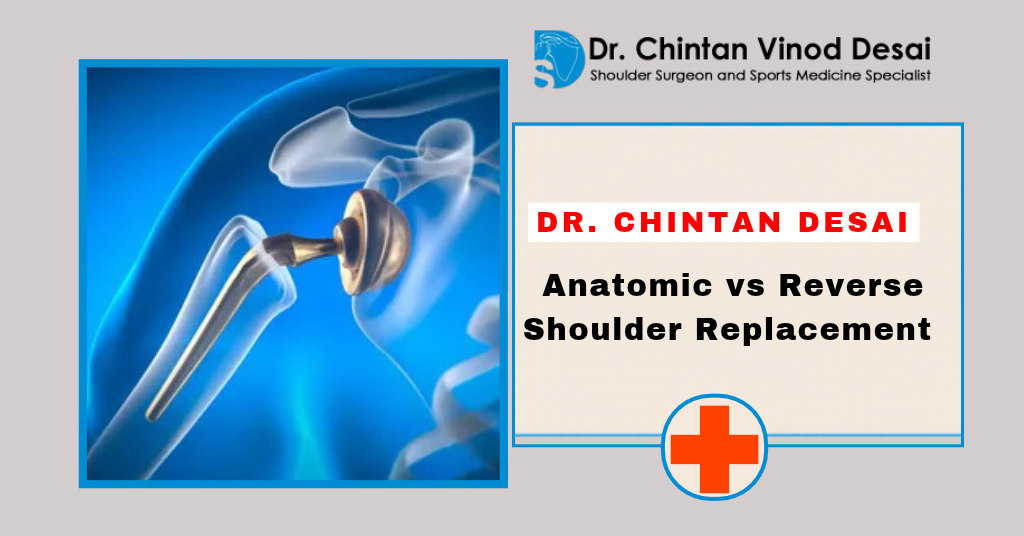
Shoulder replacement surgery may be considered when severe shoulder pain, stiffness, or weakness affects daily activities and non-surgical treatments no longer provide adequate relief.
However, not all shoulder replacements are the same.
Two commonly performed procedures are anatomic shoulder replacement and reverse shoulder replacement.
Both involve replacing damaged parts of the shoulder joint with artificial components. However, they differ in implant design, muscle requirements, and the shoulder conditions they are intended to treat.
Anatomic shoulder replacement generally recreates the natural ball-and-socket structure of the shoulder. Reverse shoulder replacement changes this arrangement to allow the deltoid muscle to contribute more effectively to arm movement when the rotator cuff is significantly damaged.
Which shoulder replacement is right for you?
The answer depends on several factors, including the condition of your rotator cuff tendons, severity of shoulder arthritis, bone quality, age, activity requirements, and expected functional outcomes.
Dr. Chintan Desai, a shoulder surgeon in Mumbai, evaluates these factors to determine whether anatomic shoulder replacement, reverse shoulder replacement, or another treatment may be appropriate.
What Is Shoulder Replacement Surgery?
Shoulder replacement surgery, also called shoulder arthroplasty, is a procedure in which damaged joint surfaces are replaced with artificial components.
The shoulder is a ball-and-socket joint formed by:
- Humeral head: The rounded upper portion of the arm bone that forms the ball.
- Glenoid: The shallow socket located on the shoulder blade.
- Articular cartilage: The smooth tissue covering the joint surfaces.
- Rotator cuff: A group of muscles and tendons that stabilize the shoulder and help control movement.
- Deltoid muscle: A large muscle surrounding the shoulder that contributes to lifting the arm.
When the joint surfaces become severely damaged due to arthritis, injury, or other conditions, patients may experience persistent pain, stiffness, and difficulty moving the shoulder.
Shoulder replacement aims to reduce pain and improve useful shoulder function.
The choice between anatomic and reverse shoulder replacement depends largely on how well the rotator cuff functions and whether the shoulder joint has sufficient bone support.
What Is Anatomic Shoulder Replacement?

Anatomic shoulder replacement, also called anatomical total shoulder arthroplasty, is designed to recreate the shoulder’s natural ball-and-socket arrangement.
During the procedure, the damaged humeral head is replaced with an artificial ball, while the glenoid surface is replaced with an artificial socket component.
The implant is positioned to resemble the normal anatomy of the shoulder.
How Does Anatomic Shoulder Replacement Work?
In a healthy shoulder, the rotator cuff muscles help keep the humeral head centered within the glenoid socket during movement.
Anatomic shoulder replacement relies on this muscular support.
When the rotator cuff is intact or sufficiently functional, the artificial joint can work with the surrounding muscles to support controlled shoulder movement.
Who May Need Anatomic Shoulder Replacement?
Anatomic shoulder replacement may be considered for selected patients with:
- Advanced shoulder osteoarthritis.
- Persistent shoulder pain despite appropriate non-surgical treatment.
- An intact or functional rotator cuff.
- Suitable glenoid bone quality.
- Significant stiffness or functional limitations.
- Certain inflammatory or degenerative joint conditions.
The procedure is commonly considered when the shoulder joint is severely arthritic but the rotator cuff can still support normal joint mechanics.
Important: Anatomic shoulder replacement may be less suitable when there is a massive, irreparable rotator cuff tear or severe tendon dysfunction.
What Is Reverse Shoulder Replacement?
Reverse shoulder replacement is a type of shoulder arthroplasty that changes the normal arrangement of the ball and socket.
In this procedure:
- An artificial ball is attached to the glenoid side of the shoulder.
- An artificial socket is attached to the upper arm bone.
This reversed arrangement changes the mechanics of the shoulder joint.
How Does Reverse Shoulder Replacement Work?
In a normal shoulder, the rotator cuff helps stabilize the humeral head and supports arm movement.
When the rotator cuff is severely damaged, the shoulder may lose stability and the ability to lift the arm effectively.
Reverse shoulder replacement changes the joint’s center of rotation and mechanical leverage.
This allows the deltoid muscle to contribute more effectively to lifting the arm, even when the rotator cuff is substantially deficient.
However, reverse shoulder replacement does not recreate the original rotator cuff muscles or guarantee normal shoulder movement.
Who May Need Reverse Shoulder Replacement?
Reverse shoulder replacement may be considered for selected patients with:
- Massive, irreparable rotator cuff tears.
- Rotator cuff tear arthropathy.
- Advanced shoulder arthritis with significant rotator cuff dysfunction.
- Certain complex proximal humerus fractures.
- Severe shoulder weakness associated with structural joint damage.
- Selected cases of failed previous shoulder replacement.
- Significant glenoid deformity or other anatomical factors that make anatomic replacement less suitable.
The procedure may also be considered for selected patients with advanced arthritis and an intact rotator cuff when bone deformity or other clinical factors favor a reverse design.
Anatomic vs Reverse Shoulder Replacement: Key Differences
Although both procedures replace damaged shoulder joint surfaces, they have different mechanical designs and indications.
| Feature | Anatomic Shoulder Replacement | Reverse Shoulder Replacement |
| Implant design | Recreates normal ball-and-socket anatomy | Reverses the ball-and-socket arrangement |
| Rotator cuff function | Generally requires a functional rotator cuff | Can work despite substantial rotator cuff deficiency |
| Main muscle support | Rotator cuff and deltoid | Greater reliance on the deltoid |
| Common indication | Advanced arthritis with functional rotator cuff | Cuff tear arthropathy and selected other conditions |
| Joint surfaces | Replaced | Replaced |
| Shoulder movement | Depends on rotator cuff and other muscles | Depends on deltoid and remaining muscles |
| Bone requirements | Suitable glenoid bone support | Suitable fixation and bone support for reverse components |
| Rehabilitation | Several months | Several months |
| Potential complications | Rotator cuff failure, loosening, instability | Instability, acromial stress fracture, loosening |
| Main objective | Reduce pain and restore useful movement | Reduce pain and improve function despite cuff deficiency |
Neither procedure is automatically better.
The most appropriate replacement depends on the condition of the individual shoulder.
Why Is Rotator Cuff Function Important When Choosing Shoulder Replacement?
The rotator cuff plays an important role in shoulder stability.
It consists of four muscles and their tendons:
- Supraspinatus.
- Infraspinatus.
- Subscapularis.
- Teres minor.
These muscles help control rotation, stabilize the joint, and maintain the position of the humeral head.
When the Rotator Cuff Is Functional
Anatomic shoulder replacement may be appropriate because the rotator cuff can help maintain joint stability and support movement.
When the Rotator Cuff Is Severely Damaged
A massive, irreparable rotator cuff tear may prevent the muscles from stabilizing the shoulder adequately.
In such cases, anatomic replacement may be associated with abnormal joint mechanics and an increased risk of failure.
Reverse shoulder replacement may be considered because its design reduces dependence on the rotator cuff.
However, the condition of the deltoid muscle, remaining tendons, and shoulder nerves must also be assessed.
Which Shoulder Replacement Is Better for Shoulder Arthritis?
The choice depends on the severity of arthritis and the condition of the surrounding tissues.
Shoulder Arthritis With an Intact Rotator Cuff
For patients with advanced osteoarthritis and a functional rotator cuff, anatomic total shoulder replacement may be considered.
It recreates the natural joint arrangement and may provide useful pain relief and movement.
Shoulder Arthritis With Rotator Cuff Damage
When advanced arthritis is accompanied by severe rotator cuff deficiency, reverse shoulder replacement may be more appropriate.
Shoulder Arthritis With Severe Glenoid Bone Deformity
Some patients have substantial wear, bone loss, or deformity of the glenoid socket.
These changes can affect implant positioning and stability.
Reverse shoulder replacement may be considered in selected cases, even when the rotator cuff is functional.
The decision should be based on imaging, physical examination, bone quality, muscle function, and expected outcomes rather than arthritis severity alone.
Which Procedure Is Suitable for Massive Rotator Cuff Tears?
A massive rotator cuff tear may involve multiple tendons or extensive tendon damage.
Some massive tears remain repairable, while others cannot be reliably repaired because of tendon retraction, muscle degeneration, or poor tissue quality.
When the Tear Is Repairable
Rotator cuff repair may be considered instead of shoulder replacement.
When the Tear Is Irreparable but Arthritis Is Limited
Joint-preserving treatments may be discussed in selected patients.
These can include:
- Physiotherapy.
- Partial rotator cuff repair.
- Superior capsular reconstruction.
- Tendon transfer.
- Other procedures based on the tear pattern and shoulder function.
When the Tear Is Irreparable With Advanced Arthritis
Reverse shoulder replacement may be considered, particularly when pain and functional limitations are significant.
However, not every irreparable rotator cuff tear requires shoulder replacement.
How Is Anatomic Shoulder Replacement Performed?

The exact surgical technique depends on the patient’s anatomy and implant selection.
Step 1: Preoperative Assessment
The surgeon reviews the patient’s medical history, shoulder movement, rotator cuff function, and imaging results.
X-rays, CT scans, MRI, or ultrasound may be used when clinically indicated.
Step 2: Anaesthesia
The procedure is usually performed under general anaesthesia, often combined with a regional nerve block for pain control.
Step 3: Surgical Exposure
The surgeon makes an incision to access the shoulder joint.
The approach depends on the planned procedure and anatomical considerations.
Step 4: Preparation of the Humeral Head
The damaged humeral head is removed or prepared to accommodate the artificial ball component.
Step 5: Glenoid Preparation
The damaged glenoid surface is prepared for placement of an artificial socket component.
Step 6: Implant Placement
The artificial components are positioned and secured using the appropriate fixation technique.
Step 7: Joint Assessment and Closure
The surgeon checks joint stability, movement, and component positioning.
Soft tissues are managed according to the surgical technique, and the incision is closed.
The rotator cuff, particularly the subscapularis when surgically managed, may require protection during postoperative rehabilitation.
How Is Reverse Shoulder Replacement Performed?
Reverse shoulder replacement involves similar general stages but uses a different implant configuration.
Step 1: Shoulder Assessment
The surgeon evaluates the rotator cuff, deltoid function, joint cartilage, bone quality, and shoulder anatomy.
Step 2: Joint Preparation
The damaged humeral head and glenoid surfaces are prepared.
Step 3: Glenoid Component Placement
A baseplate is secured to the glenoid.
A rounded artificial component, called the glenosphere, is attached to the baseplate.
Step 4: Humeral Component Placement
A humeral implant with a socket-shaped bearing is positioned in the upper arm bone.
Step 5: Stability Assessment
The surgeon checks implant positioning, joint stability, and movement.
Step 6: Wound Closure
The incision is closed, and the patient begins postoperative recovery and rehabilitation according to the surgeon’s instructions.
Reverse shoulder replacement requires careful implant positioning and adequate fixation to support joint function.
Anatomic vs Reverse Shoulder Replacement: Recovery Time
Recovery after either procedure takes several months.
The rehabilitation programme depends on implant type, surgical approach, soft-tissue repair, bone quality, and the surgeon’s protocol.
| Recovery phase | Anatomic Shoulder Replacement | Reverse Shoulder Replacement |
| First 1–2 weeks | Pain control, wound care, sling protection | Pain control, wound care, sling protection |
| Approximately 2–6 weeks | Controlled movement while protecting repaired tissues | Controlled movement according to stability and surgical instructions |
| Approximately 6–12 weeks | Gradual progression of active movement | Gradual progression of active movement |
| Approximately 3–6 months | Progressive strengthening and functional activities | Deltoid and shoulder muscle strengthening |
| Approximately 6–12 months | Continued functional improvement | Continued functional improvement |
These timelines are approximate and should not replace the treating surgeon’s rehabilitation instructions.
Recovery After Anatomic Shoulder Replacement
Anatomic replacement rehabilitation often includes protection of repaired soft tissues, particularly when the subscapularis tendon has been detached and repaired during surgery.
Excessive early external rotation, lifting, or active internal rotation may be restricted depending on the surgical approach.
Recovery After Reverse Shoulder Replacement
Reverse replacement rehabilitation focuses on protecting the joint, improving controlled movement, and gradually strengthening the deltoid and surrounding muscles.
Certain combined arm positions may be restricted during early recovery because they can increase instability risk.
When Can Patients Return to Daily Activities?
Some light activities may resume within the first several weeks, depending on the procedure and individual recovery.
More demanding activities generally require additional healing and rehabilitation.
Driving, lifting, gym exercises, and sports should resume only after appropriate medical clearance.
Which Surgery Provides Better Shoulder Movement?
Neither procedure guarantees greater movement for every patient.
Anatomic shoulder replacement may provide good movement when the rotator cuff is functional and the joint has suitable anatomy.
Reverse shoulder replacement may improve arm elevation in patients whose rotator cuff is severely deficient.
However, the amount of movement regained depends on:
- Preoperative shoulder function.
- Rotator cuff and deltoid condition.
- Joint stiffness.
- Bone quality.
- Implant positioning.
- Rehabilitation.
- Associated nerve or muscle problems.
Some patients may continue to have limitations in internal rotation, external rotation, or overhead movement after either procedure.
Which Shoulder Replacement Has Better Long-Term Results?
Both anatomic and reverse shoulder replacements can provide meaningful pain relief and functional improvement in appropriately selected patients.
However, their long-term results are influenced by different factors.
Anatomic Shoulder Replacement
Long-term function depends partly on maintaining adequate rotator cuff function and stable implant fixation.
Potential problems include glenoid component loosening, rotator cuff deterioration, and implant wear.
Reverse Shoulder Replacement
Long-term function depends on implant stability, deltoid function, bone quality, and component fixation.
Potential complications include instability, implant loosening, scapular notching, and stress fractures involving the acromion or scapular spine.
Both procedures may eventually require revision surgery in some patients.
Implant survival statistics from different studies should not be compared without considering patient selection, follow-up duration, implant design, and surgical indication.
What Are the Risks of Anatomic Shoulder Replacement?
Potential complications include:
- Infection.
- Bleeding or blood clots.
- Nerve or blood vessel injury.
- Persistent pain.
- Shoulder stiffness.
- Rotator cuff or subscapularis failure.
- Implant loosening.
- Instability.
- Periprosthetic fracture.
- Need for revision surgery.
The individual risk depends on the patient’s health, bone quality, shoulder condition, and surgical factors.
What Are the Risks of Reverse Shoulder Replacement?
Reverse shoulder replacement has some complications that differ from those associated with anatomic replacement.
Potential risks include:
- Infection.
- Joint instability or dislocation.
- Implant loosening.
- Acromial or scapular spine stress fracture.
- Scapular notching.
- Nerve injury.
- Periprosthetic fracture.
- Persistent weakness or restricted movement.
- Need for revision surgery.
Not every patient experiences these complications.
A detailed discussion of the expected benefits, limitations, and risks is important before either procedure.
Does Age Determine Which Shoulder Replacement Is Better?
Age is one consideration, but it is not the only factor.
Historically, reverse shoulder replacement was commonly used in older patients with severe rotator cuff dysfunction.
However, its indications have expanded, and it may be considered in selected patients with other complex shoulder conditions.
Likewise, anatomic replacement may be appropriate for older patients with functional rotator cuff tendons and suitable bone quality.
Factors such as muscle function, joint deformity, bone quality, medical fitness, and activity requirements may be more important than age alone.
Can Anatomic Shoulder Replacement Be Converted to Reverse Shoulder Replacement?
Yes. In selected cases, a failed anatomic shoulder replacement may be revised to a reverse shoulder replacement.
Possible reasons include:
- Rotator cuff failure.
- Instability.
- Implant loosening.
- Progressive joint dysfunction.
- Other implant-related complications.
However, revision surgery is generally more complex than primary replacement.
Bone loss, infection, implant design, and remaining soft-tissue function influence whether conversion is feasible.
Not every failed anatomic replacement can be managed with a straightforward conversion.
What Is the Cost Difference Between Anatomic and Reverse Shoulder Replacement in Mumbai?
The cost of anatomic and reverse shoulder replacement surgery in Mumbai varies according to the procedure, implant system, hospital, and individual surgical requirements.
Reverse shoulder replacement may involve different implant components and fixation requirements from anatomic replacement.
However, it is not appropriate to assume that one procedure will always cost more.
Factors That Influence Surgery Cost
- Implant type: Different implant designs and manufacturers have different prices.
- Surgical complexity: Bone deformity, previous surgery, and associated injuries can increase surgical requirements.
- Hospital charges: Operating theatre, room category, and length of stay influence costs.
- Surgeon and anaesthesia fees: Professional charges vary by procedure and hospital.
- Investigations: X-rays, CT scans, blood tests, and other assessments may be required.
- Rehabilitation: Physiotherapy and follow-up care contribute to overall expenses.
- Additional treatment: Complications or prolonged hospitalization can increase costs.
Patients should request an itemized estimate after the surgeon confirms the planned procedure.
The choice between anatomic and reverse shoulder replacement should be based primarily on clinical suitability rather than implant price alone.
How Does a Shoulder Surgeon Decide Which Replacement Is Right for You?
A detailed assessment is necessary before recommending either procedure.
1. Medical History
The surgeon reviews:
- Duration and severity of pain.
- Previous shoulder injuries.
- History of shoulder surgery.
- Response to physiotherapy and medication.
- Work and activity requirements.
- Other medical conditions.
2. Physical Examination
The examination may include:
- Active and passive shoulder movement.
- Rotator cuff strength.
- Deltoid function.
- Shoulder stability.
- Joint stiffness.
- Neurological function.
3. Imaging Evaluation
X-rays help assess arthritis, joint alignment, and bone changes.
CT scans may be used to evaluate glenoid bone loss, deformity, and implant planning.
MRI or ultrasound may be used to assess rotator cuff integrity and muscle condition.
4. Assessment of Bone and Muscle Quality
The surgeon evaluates whether the remaining bone can support the implant and whether the surrounding muscles can provide adequate shoulder function.
5. Discussion of Treatment Goals
Patients may have different priorities, including:
- Relief from persistent pain.
- Improved ability to dress or perform personal care.
- Better arm elevation.
- Greater independence in daily activities.
- Returning to selected recreational activities.
The surgeon considers these goals alongside the expected benefits and limitations of each procedure.
When Should You Consult a Shoulder Replacement Specialist?
Consider consulting a shoulder specialist if you experience:
- Persistent shoulder pain despite appropriate treatment.
- Severe stiffness affecting daily activities.
- Difficulty lifting the arm.
- Significant shoulder weakness.
- Night pain that interferes with sleep.
- A diagnosed massive rotator cuff tear with major dysfunction.
- Advanced shoulder arthritis.
- Persistent problems after previous shoulder surgery.
An accurate diagnosis can help determine whether continued non-surgical treatment, rotator cuff surgery, or shoulder replacement is appropriate.
Dr. Chintan Desai at Desai Shoulder Clinic, Mumbai, evaluates shoulder conditions and discusses treatment options based on individual clinical findings.
Frequently Asked Questions About Anatomic vs Reverse Shoulder Replacement
1. What is the main difference between anatomic and reverse shoulder replacement?
Anatomic shoulder replacement recreates the normal ball-and-socket arrangement and generally relies on a functional rotator cuff. Reverse shoulder replacement reverses the joint arrangement to allow greater reliance on the deltoid muscle.
2. Which is better: anatomic or reverse shoulder replacement?
Neither is better for every patient. Anatomic replacement may be suitable for advanced arthritis with a functional rotator cuff, while reverse replacement may be appropriate when the rotator cuff is severely deficient or other anatomical factors favor it.
3. Is reverse shoulder replacement only for elderly patients?
No. Although commonly performed in older adults, reverse shoulder replacement may be considered in selected younger patients when the clinical indications are appropriate.
4. Can reverse shoulder replacement be performed without a rotator cuff?
Reverse shoulder replacement can function despite substantial rotator cuff deficiency because it relies more on the deltoid muscle. However, adequate deltoid function and suitable joint conditions remain important.
5. How long does recovery take after anatomic shoulder replacement?
Recovery usually takes several months. Many patients gradually improve during the first three to six months, with further functional recovery continuing for six to twelve months or longer.
6. How long does recovery take after reverse shoulder replacement?
Rehabilitation generally continues for several months. Movement and strength may improve progressively over six to twelve months, depending on the shoulder condition and individual recovery.
7. Which shoulder replacement lasts longer?
Both procedures can provide long-term function. Implant longevity depends on patient selection, implant design, bone quality, activity level, and complications. Neither procedure has a guaranteed lifespan.
8. Can I lift weights after shoulder replacement?
Some patients may return to selected resistance exercises after recovery, but heavy lifting and certain high-demand activities may remain restricted. The surgeon should provide individualized guidance.
9. Is anatomic shoulder replacement possible with a rotator cuff tear?
It depends on the size and functional significance of the tear. Some limited, repairable tendon abnormalities may be compatible with anatomic replacement, while massive irreparable tears generally make it less suitable.
10. Does reverse shoulder replacement provide normal shoulder movement?
Not necessarily. Reverse replacement may improve arm elevation and daily function, but normal strength and unrestricted movement are not guaranteed.
11. Is reverse shoulder replacement more expensive than anatomic replacement?
Costs vary according to implant design, hospital charges, surgical complexity, and other factors. A personalized estimate is required for a meaningful comparison.
12. Can shoulder replacement be avoided with physiotherapy?
Some patients can manage symptoms through physiotherapy, medication, and activity modification. However, advanced joint damage with severe persistent symptoms may require discussion of surgical options.
13. Is shoulder replacement surgery painful?
Postoperative discomfort is expected, especially during early recovery. Pain management may include prescribed medication, regional anaesthesia techniques, and a structured rehabilitation programme.
14. Can a failed anatomic shoulder replacement be converted to a reverse replacement?
Yes, in selected cases. The feasibility depends on bone quality, existing implants, rotator cuff function, and the reason for failure.
15. Which doctor should I consult for shoulder replacement surgery in Mumbai?
An orthopaedic shoulder specialist can evaluate joint damage, rotator cuff function, and imaging findings to determine whether anatomic replacement, reverse replacement, or another treatment is appropriate.
Conclusion
Anatomic and reverse shoulder replacement are different surgical approaches designed to address specific shoulder conditions.
Anatomic shoulder replacement generally recreates the natural joint arrangement and is commonly considered when the rotator cuff is functional.
Reverse shoulder replacement changes the joint mechanics and may help selected patients with severe rotator cuff deficiency, rotator cuff tear arthropathy, or other complex shoulder conditions.
Neither procedure is automatically the right choice for every patient.
The decision depends on shoulder arthritis, rotator cuff function, bone quality, symptoms, activity requirements, and expected functional outcomes.
If persistent shoulder pain, stiffness, or weakness is affecting your daily activities, consult Dr. Chintan Desai at Desai Shoulder Clinic, Mumbai, for a detailed shoulder evaluation and discussion of suitable treatment options.