When shoulder pain or an injury requires surgery, patients may hear about two different approaches: shoulder arthroscopy and open shoulder surgery. While both can be used to treat shoulder conditions, they differ in how the surgeon accesses and treats the affected structures.
Shoulder arthroscopy uses a small camera and specialized instruments inserted through small incisions. Open surgery uses a larger incision to directly access the affected area.
The choice between these approaches depends on the type and severity of the shoulder problem, the structures involved, previous treatments, and the patient’s individual needs.
Dr. Chintan Desai, an experienced shoulder surgeon in Mumbai, explains the differences between shoulder arthroscopy and open surgery, including their benefits, limitations, recovery, and when each approach may be appropriate.
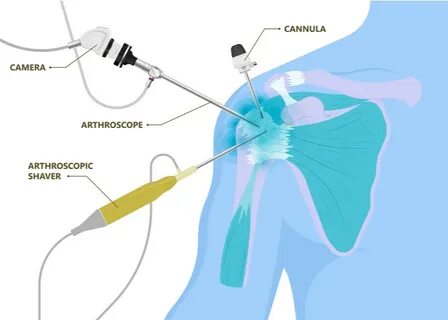
What Is Shoulder Arthroscopy?
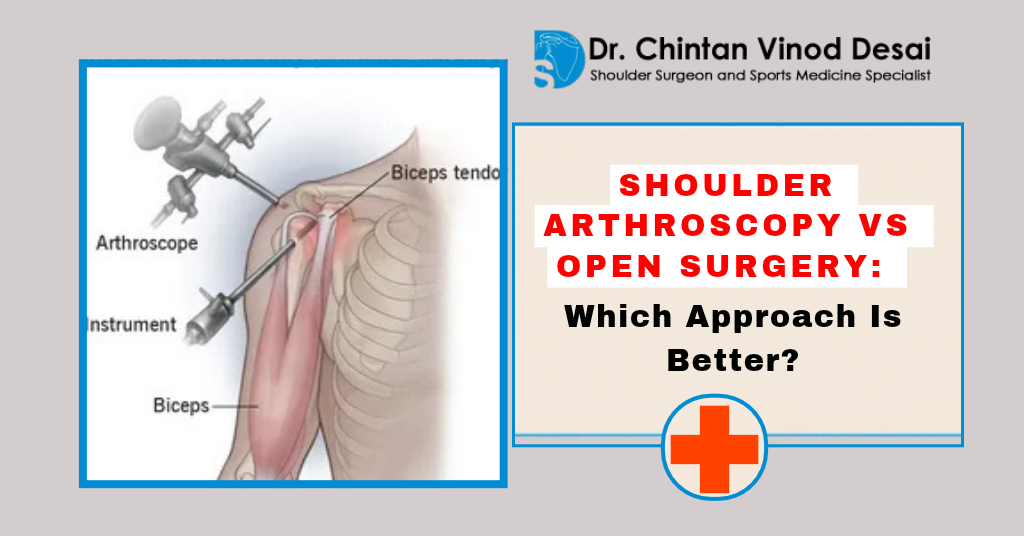
Shoulder arthroscopy is a minimally invasive surgical procedure used to diagnose and treat problems inside and around the shoulder joint.
A small camera called an arthroscope is inserted through a small incision. The camera provides a magnified view of the shoulder on a monitor, allowing the surgeon to examine structures such as:
- Rotator cuff tendons
- Labrum
- Cartilage
- Ligaments
- Inflamed or damaged tissues
Specialized instruments can then be inserted through additional small openings to perform the required treatment.
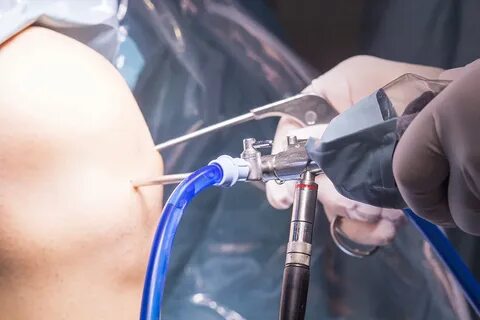
Shoulder arthroscopy may be used for conditions such as:
- Rotator cuff tears
- Labral tears
- Shoulder instability
- Certain impingement-related problems
- Some cartilage injuries
- Other selected shoulder conditions
The specific procedure depends on the underlying diagnosis.
What Is Open Shoulder Surgery?
Open shoulder surgery involves making a larger incision to directly access the affected structures.
Depending on the condition, open surgery may allow the surgeon to directly repair or reconstruct damaged tissues or address certain structural problems.
Open surgery may be considered when:
- There is significant bone loss
- A complex reconstruction is required
- Previous surgery has failed
- The injury cannot be adequately treated arthroscopically
- The surgeon determines that an open approach is more appropriate
Open surgery is not necessarily better or worse than arthroscopy. The appropriate approach depends on the patient’s specific condition.
Shoulder Arthroscopy vs Open Surgery: Key Differences
1. Surgical Approach
Shoulder Arthroscopy
- Uses small incisions
- Uses a camera to visualize the joint
- Specialized instruments are inserted through additional small openings
- Allows treatment of many conditions without a large incision
Open Surgery
- Uses a larger incision
- Provides direct access to the affected structures
- May be necessary for certain complex repairs or reconstructions
2. Conditions Treated
The two approaches can be used for different shoulder problems.
Arthroscopy is commonly used for selected:
- Rotator cuff repairs
- Labral repairs
- Shoulder stabilization procedures
- Removal of damaged or inflamed tissue
Open surgery may be considered for selected:
- Complex shoulder reconstructions
- Significant bone loss
- Certain revision procedures
- Conditions where arthroscopic treatment may not be sufficient
Your surgeon determines the appropriate approach after evaluating the injury and imaging findings.
3. Incision Size
One of the most noticeable differences is the size of the surgical access.
Arthroscopy generally involves several small incisions through which the camera and instruments are inserted.
Open surgery requires a larger incision to provide direct access to the surgical area.
However, incision size alone does not determine which procedure is appropriate.
4. Recovery
Recovery depends more on what is repaired or reconstructed than simply whether the surgery is arthroscopic or open.
After arthroscopy, some patients may have a relatively faster early recovery because the surgical access is smaller. However, procedures such as rotator cuff or labral repair still require significant healing and rehabilitation.
Open surgery can involve a longer recovery in some cases because of the extent of the surgical procedure and tissue involvement.
Recovery may include:
- Sling support
- Pain management
- Gradual restoration of movement
- Physiotherapy
- Progressive strengthening
- Gradual return to daily activities and sports
Benefits of Shoulder Arthroscopy
When arthroscopy is appropriate, potential benefits include:
- Smaller incisions
- Less disruption of surrounding tissues
- Direct visualization of the joint
- Ability to treat multiple structures through small access points
- Potentially less post-operative discomfort in some procedures
- Gradual return to normal activities with rehabilitation
However, arthroscopy is not appropriate for every shoulder condition.
Limitations of Shoulder Arthroscopy
Arthroscopy may not be the best approach when:
- There is substantial bone loss
- A complex reconstruction is required
- Previous stabilization surgery has failed
- The condition cannot be adequately addressed through arthroscopic techniques
In these situations, an open procedure or another surgical technique may be considered.
Benefits of Open Shoulder Surgery
Open surgery can provide:
- Direct access to the affected structures
- Ability to address certain complex injuries
- Appropriate exposure for selected reconstructions
- An option for some patients where arthroscopy is not suitable
The potential benefits depend on the specific procedure being performed.
Limitations of Open Shoulder Surgery
Because open procedures generally involve a larger incision, they may involve:
- More disruption of surrounding tissues
- A larger surgical wound
- Greater post-operative discomfort in some cases
- A longer recovery for certain procedures
- A visible surgical scar
However, these factors need to be considered alongside the potential benefits of treating the underlying condition appropriately.
How Is Shoulder Arthroscopy Performed?
The exact procedure depends on the condition being treated.
1. Anaesthesia
Anaesthesia is administered before the procedure. In selected cases, a nerve block may also be used to help manage pain after surgery.
2. Arthroscopic Evaluation
Small incisions are made around the shoulder.
The arthroscope is inserted through one opening, while sterile fluid is introduced into the joint to improve visualization.
3. Treatment
Specialized instruments are introduced through additional openings.
Depending on the condition, the surgeon may:
- Repair a rotator cuff tear
- Repair a labral tear
- Stabilize the shoulder
- Remove damaged tissue
- Address selected inflammatory or structural problems
4. Closure
The small incisions are closed using stitches or surgical strips, and the shoulder may be placed in a sling depending on the procedure.
How Is Open Shoulder Surgery Performed?
The exact steps vary according to the condition being treated.
Generally:
1. Anaesthesia
The patient receives appropriate anaesthesia before surgery.
2. Surgical Access
A larger incision is made to provide direct access to the affected shoulder structures.
3. Repair or Reconstruction
The surgeon directly treats the underlying problem.
This may involve:
- Repairing damaged tissues
- Reconstructing stabilizing structures
- Addressing bone defects
- Performing another procedure appropriate to the condition
4. Closure and Protection
The incision is closed, and the shoulder may be supported with a sling during the early recovery period.
Recovery After Shoulder Arthroscopy
Recovery varies considerably depending on the procedure performed.
First Few Days
You may experience:
- Pain
- Swelling
- Stiffness
The arm may be supported in a sling.
Weeks 1–4
The focus is generally on:
- Protecting the repair
- Controlled movement
- Managing pain and swelling
- Beginning prescribed physiotherapy
Months 2–4
Rehabilitation may gradually focus on:
- Improving range of motion
- Restoring muscle strength
- Functional movements
Months 4–6 and Beyond
Depending on healing and the procedure performed, patients may gradually progress toward:
- Normal activities
- Fitness
- Work-related activities
- Sports-specific rehabilitation
The recovery timeline varies between individuals.
Recovery After Open Shoulder Surgery
Recovery depends on the type of open surgery performed.
The initial phase may involve:
- Sling support
- Pain management
- Wound care
- Controlled shoulder movement
As healing progresses, physiotherapy may focus on restoring:
- Range of motion
- Shoulder strength
- Joint stability
- Functional movement
Return to sports and demanding activities should be guided by the surgeon and physiotherapy team.
Is Shoulder Arthroscopy Always Better Than Open Surgery?
No.
The goal is not to choose the procedure with the smallest incision; it is to choose the approach that can safely and effectively address the underlying shoulder problem.
Arthroscopy may be appropriate for many soft-tissue injuries and selected shoulder conditions.
Open surgery may be more appropriate for certain complex injuries, significant bone loss, revision procedures, or reconstructions.
The decision should be based on the patient’s diagnosis, imaging findings, previous treatment, activity requirements, and overall shoulder condition.
Which Approach Has a Faster Recovery?
It depends on the surgery being performed.
A straightforward arthroscopic procedure may have a quicker early recovery than some open procedures. However, an arthroscopic rotator cuff or labral repair can still require several months of rehabilitation.
Similarly, recovery after open surgery varies according to the procedure.
Therefore, the type of repair is often more important than whether the procedure is simply described as arthroscopic or open.
Can Shoulder Arthroscopy Reduce Scarring?
Arthroscopy generally uses smaller incisions than open surgery, so the resulting scars are usually smaller.
However, scar formation varies between individuals and depends on:
- Surgical technique
- Number of incisions
- Healing response
- Skin characteristics
- Post-operative wound care
No surgical approach can guarantee that a scar will not develop.
When Should You Consult a Shoulder Specialist?
Consider consulting a shoulder specialist if you have:
- Persistent shoulder pain
- Difficulty raising your arm
- Shoulder weakness
- Recurrent dislocation
- Shoulder instability
- Clicking or catching
- Pain affecting sleep
- Symptoms that continue despite physiotherapy
- A shoulder injury that affects sports or daily activities
A proper clinical assessment can help determine the underlying cause and appropriate treatment options.
How Is the Right Surgical Approach Chosen?
Your shoulder specialist may consider:
- Type of shoulder injury
- Severity of tissue damage
- Bone involvement
- Presence of instability
- Previous shoulder surgery
- Age
- Activity level
- Sports requirements
- Response to non-surgical treatment
Imaging such as X-rays, MRI, or CT scans may also be used when appropriate.
Dr. Chintan Desai evaluates these factors to determine whether non-surgical treatment, arthroscopy, open surgery, or another treatment approach is appropriate.
Frequently Asked Questions About Shoulder Arthroscopy vs Open Surgery
1.Is shoulder arthroscopy less painful than open surgery?
Arthroscopy uses smaller incisions and may result in less early post-operative discomfort for some procedures. However, pain also depends on the type and extent of surgery performed.
2.Is open shoulder surgery more successful?
Not necessarily. Success depends on the underlying condition, the appropriate surgical technique, healing, and rehabilitation. Open surgery may be the better option for certain conditions.
3.How long does recovery take after shoulder surgery?
Recovery varies depending on the procedure. Some patients may return to light activities relatively early, while tendon repairs, stabilization procedures, and complex reconstructions can require several months of rehabilitation.
4.Can every shoulder surgery be done arthroscopically?
No. Some conditions require or may be better treated with an open approach, particularly when significant bone reconstruction or complex revision surgery is needed.
5.Will I need physiotherapy after shoulder surgery?
Physiotherapy is commonly an important part of recovery. The exercises and timing depend on the procedure performed and the stage of healing.
6.How do I know which shoulder surgery I need?
The appropriate treatment can only be determined after evaluating your symptoms, physical examination, imaging findings, and specific shoulder condition.
Conclusion
Shoulder arthroscopy and open shoulder surgery are different surgical approaches, and neither is universally better.
Arthroscopy provides a minimally invasive way to diagnose and treat many shoulder conditions through small incisions. Open surgery remains an important option for selected complex injuries, reconstructions, significant bone loss, and some revision procedures.
The most appropriate approach depends on the underlying shoulder problem rather than the size of the incision alone.
If shoulder pain, instability, weakness, or an injury is affecting your daily life or sports activities, consult Dr. Chintan Desai at Desai Shoulder Clinic for an evaluation and personalized treatment plan.